Showing posts with label Viral Marketing. Show all posts

Tuesday, January 24, 2012

How Sweet It Is: New Twitter Followers Activate U.K. Agency's Rube Goldberg-Esque Gumball Chute

In the marketing profession, we see a ton of innovative, clever, and creative ideas (after all, that's at we're paid TO DO, right?) every day. Now, admittedly, some are much better than others. Hey, just because we said they're innovative or creative doesn't mean that they're quality, or that they hit the mark! :) In any case, this is one of the more on-target creative concepts we've seen in a while.

As reported in this piece on Adweek's AdFreak blog, U.K. brand communications agency Uniform has created a fun...and rather elaborate and whimsical...gumball machine  dubbed Sweet Tweet ― which spits out a sphere every time a user follows the company on Twitter. The machine, which is activated when the user clicks "follow," then sends a jumbo gumball down a winding chute complete with twists, turns, drops, jumps, ramps, and even multiple 360-degree loops directly into the agency's studio. In return, Uniform automatically sends out an @reply to the new follower with a link to the following video of the machine in action.

According to Uniform's future director Pete Thomas, "We wanted to create a physical app that connected our studio to our Twitter followers, raising awareness and alerting us all to each new follower." The agency specializes in creating real-world Internet-enabled experiences, so the Rube Goldberg-esque contraption seems to reinforce that positioning and expertise.

Give Sweet Tweet a whirl by checking out the video below of the gumball machine as it goes to work:

Thursday, November 17, 2011

Who Is It?: Who's Using Geosocial And Location-Based Services?

Here at CMAC, we love geosocial and location-based services, such as Facebook PlacesGowalla, and Foursquare, because they're fun, and, more importantly, they provide creative depth, additional interesting dimensions, and serious promotional firepower to companies' social media marketing efforts. In addition to their use by major high-profile consumer brands (and even the White House!), local retailers across the country are effectively utilizing Facebook Places and Foursquare to drive significant in-store traffic, coupon redemption, and sell-through of specific products and services. (Here's a tip:  the next time you're at Chili's, check in to the restaurant on Foursquare, and score yourself some FREE chips and salsa for doing so!)

But who...exactly...is using these services? Unlike extensive demographic research for other social media channels, there's been little data on location-based service (LBS) users. Well, at least up until now...

According to a recent study by Column Five Media and Flowtown, men outnumber women, although just barely (59% to 57%, respectively), as the percentage of all smartphone owners using these technologies. The majority of LBS users are between the ages of 18 and 29; possess a minimum household income of $75,000; and are college graduates.

For a full rundown on all the findings of the study, check out the infographic below, or click here for a larger view.
As more user research in this area is conducted, we will post updates, especially since demographic continuously shift over time.

Thursday, August 25, 2011

The Power Of Word Of Mouth: A Viable Online Marketing Strategy

Much has been discussed and written about the effectiveness of word-of-mouth marketing (or buzz marketing, as it used to be known, and a term which is still occasionally used today) and how these principles now extend to the social media realm and best practices in viral marketing. 

As my friend Emanuel Rosen initially outlined in his seminal work, The Anatomy of Buzz, word-of-mouth marketing successfully leverages the power and credibility of influencers, and recruits these prominent individuals and companies to become brand ambassadors for your business and its offerings. If you're not familiar with Rosen, who is referred to as "The Godfather of Social Networks," I highly encourage you to read his book, which is now in its third edition and has sold over 100,000 copies worldwide in 12 languages. It's well worth the time to read, and much of the material in his new version (The Anatomy of Buzz Revisited) specifically deals with social media and viral marketing strategies. Also make sure to follow Rosen on Twitter (@EmanuelRosen) or the latest on buzz marketing techniques.

In the social media domain, influencers carry far more weight, and exhibit much more reach, simply by retweeting specific content, additional sharing and postings on other networks, and having their followers hanging on their every word. But the key is to connect with them in the first place. If you're successful in that regard, you can forge a direct connection to your customer base through the influencer conduit. While Facebook has it share, Twitter is full of influencers, and this impact is more noticable on Twitter...perhaps more than any other network...because of its open nature. Therefore, by tweeting promotions and product review requests to influencers on Twitter, you’ll be able to tap into a powerful word-of-mouth marketing source that is just not available anywhere else.

Just how important is word-of-mouth marketing via social media? Peruse the intriguing facts and figures below, courtesy of search engine optimization company CapSEO:
Click here to view large image of this summary.

Wednesday, May 25, 2011

The Evolution Of Spam: A Timeline Of The World's Most Hated Messages

I've been using e-mail now for business purposes for just over 15 years, and sending personal e-mails (anyone remember CompuServe or Prodigy???) dating back to my college days almost two decades ago, but it seems that spam has been omnipresent the entire time. That's probably no exaggeration, since I can remember receiving unsolicited messages from the next dorm over about some harebrained scheme concocted by a cadre of aerospace engineering students. In any case, with the advent and proliferation of social networks, the global spam epidemic (read: scourge) has become even more dangerous, problematic, and dare I say annoying, than ever before.

And that's what is so appealing about this infographic, courtesy of Column Five for Marketo, and showcased in this piece on AllTwitter. For the first time ever, check out the evolution of spam, including the interesting origin of the term (a tip of the hat to Monty Python) and how the world's most hated messages have changed over the past 150 years:

Please feel free to click here for a clearer and much larger view!

Monday, December 6, 2010

The History Of Social Media: A Stunning Visual Timeline

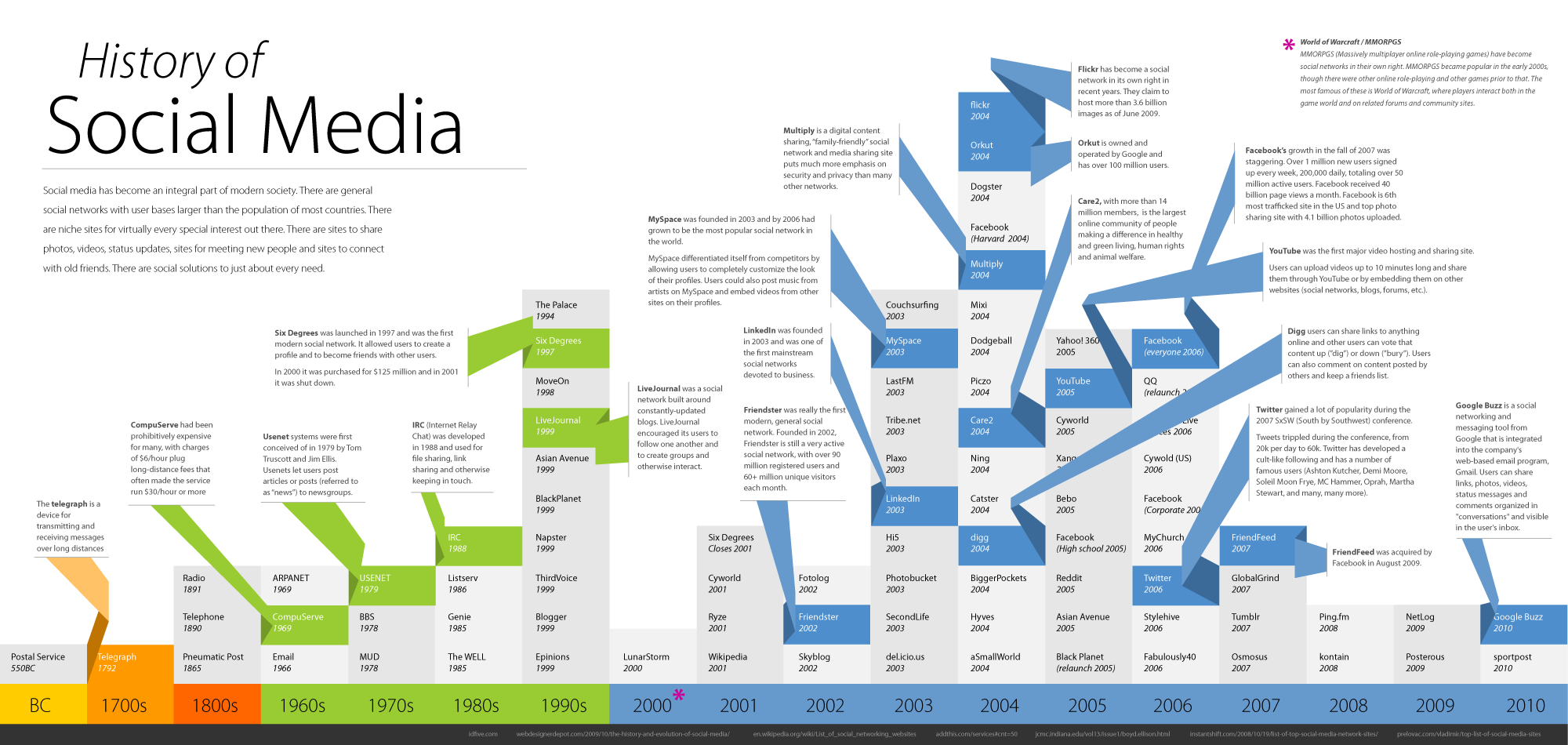
Now here's something you don't see every day, and is definitely worth a look. We, here at CMAC, love this, and we especially love well-designed images like this.

According to Barry Ritholtz on his blog, The Big Picture, we all know social media has become an integral part of modern society. It's as common nowadays as, well, breathing and blinking. Currently, there are popular social networks with user bases larger than the populations of most countries. In addition, there are niche sites for virually every special interest in existence. And there are countless sites to share photos, videos, and status updates, as well as online destinations for new people and connecting with family members and old friends. In the final analysis, there are social solutions for just about every communication need in the world.

So, at this point, now is as good a time as any to take a look at the history of social media...rendered in the following amazing and informative infographic with a comprehensive global history of the medium. You can click on the image for a larger, more detailed view:

Monday, October 25, 2010

Fame Monster Lady Gaga Continues To Rule Social Media, Viral Marketing Universe

For those keeping score at home, celebrities, professional athletes, and other noteworthy personalities continue to attract record numbers of Facebook and Twitter followers, as well as YouTube viewers. It's hard to believe that, in today's day and age, music artists such as Lady Gaga, Justin Bieber, and Britney Spears can garner more followers and eyeballs than other, and seemingly far more important, individuals such as President Barack Obama, Warren Buffett, or Nancy Pelosi. It's both impressive and mind boggling...all at the same time.

Need more proof? As reported today by Mashable and countless other print, broadcast, and online media outlets, Lady Gaga's YouTube viewership (i.e., total views of all her videos on the service) has just hit the 1 billion views milestone, with Bieber a close second at just over 962 million views. The Fame Monster announced the news via her Twitter stream this morning, as can be seen below:

Bieber is expected to hit the 1 billion mark on November 1. Incidentally, Bieber still holds the the record for the most-viewed YouTube video of all time for his smash hit song “Baby,” which has 366.5 million views as of this morning:


Monday, October 11, 2010

Trick Or Treat: Snickers' Creepy Halloween TV Spot Scares Up Viral Marketing Success

I've mentioned this before on Marketing Mulligans, but it's often quite difficult for digital marketers to predict exactly which online videos will capture the imagination of consumers and go viral. At a basic level, viral marketing success is typically determined by offering short (because we all have limited attention spans), unique (i.e., never before seen by users), humorous (laughter is the best medicine), timely (current and relevant are a powerful combination), and entertaining (we all like to escape reality for a few fleeting moments) content. However, even with these elements nailed, many videos simply never catch on. Why? Because we, as consumers, are fickle, cynical, and judgmental.

But not here. And that is what makes Snickers' latest TV ad, simply called "Grocery Store Lady," such an intriguing case study. Created by New York-based BBDO Worldwide, the 30-second spot, if you can believe it, is the first Halloween-themed ad ever for the highly-popular candy bar brand, owned by worldwide candy conglomerate Mars, Inc. Instead of alienating consumers, the commercial's creepy (and in a non-Halloween way) has scared up tons of views and traffic on multiple sites, including BuzzFeed, Huffington Post, and Consumerist, and is generating scores of comments in the blogosphere and on social media platforms.

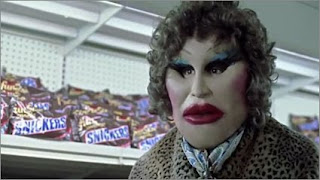
The ad is relatively straightforward. While walking down the candy aisle of her local supermarket, an innocent shopper, Mrs. Jensen, is accosted by a very tall and imposing Halloween-costumed figure (pictured below) with an unusual mask and disconcerting voice. The figure addresses the customer in a high-pitched voice, disturbingly caresses her face, and then throws a heap of Snickers bars into the frightened customer's cart. As the customer walks (read: runs) away, the figure turns to a small child who suddenly appears out of nowhere in the folds of her dress, and the kid says to the figure, "We're definitely going to her house."


Media reaction has been mixed. The Riverfront Times, an alternative news weekly in St. Louis, offers a very interesting take on the Snickers spot in which it points out there is a slightly "pervy undercurrent," but still heralds the brand's viral success and the broad consumer reaction to the ad. In a critical post on AdFreak, a popular Adweek blog, journalist David Kiefaber writes the "distressing 'Grocery Store Lady' ad for Snickers doesn't compel me to buy candy so much as call child services." And the Huffington Post calls the old lady figure "one of the scariest things we've ever seen."

Personally, I find the ad to be creepy and humorous at the same time, and it is also very different than any spot I've ever seen — and this is what ultimately accounts for the spots' viral marketing success. What do you think of the ad? Watch it yourself, and then feel free to comment below:


Monday, August 23, 2010

Twitter Gaga: Lady Gaga Now Has The Most Followers On Twitter

It's now official: world-famous pop star Lady Gaga, a.k.a. Stefani Joanne Angelina Germanotta, surpassed Britney Spears over the weekend as the Twitter user with most followers ever.

As reported in this post today on FishbowlLA, the 24-year-old American recording artist now has 5,755,982 followers on her account, @LadyGaga, as of this writing. Britney Spears, whose Twitter handle is @BritneySpears, "only" has 5,708,840 followers as of this afternoon.

To celebrate the milestone, Lady Gaga instinctively posted an inaugural video message on Twitter thanking her loyal fans, known as "Little Monsters," for making her the undisputed "Queen of the Twittisphere:"


Three related side notes: 1.) Neither Lady Gaga nor Britney Spears follows the other on Twitter; 2.) Lady Gaga has only posted 465 tweets since joining the microblogging service two years ago; and 3.) Lady Gaga also outduels Britney, who has tweeted just 431 times, in terms of sheer tweet volume.

Tuesday, August 17, 2010

Communist Oppressor North Korea Embraces Twitter...Paradoxically

As reported yesterday in stories carried by the Financial Post, Mashable, PC World, WebNewser, and scores of other media outlets around the world, the oppressive Communist country of North Korea has established its first official presence on Twitter, the micro-blogging site that is being embraced by increasing numbers of governments and world leaders.

Last week, North Korean news agency Uriminzokkiri, one of the country's few media outlets to write in English for a foreign audience, set up a Twitter account (@uriminzok). The Web site of the agency, whose name means "Our Nation," is the closest thing North Korea has to an official home page. The site carries the link to its Twitter stream in the upper right-hand corner. The account has nearly 5,000 followers (4,903, to be exact) as of this writing.

Uriminzokkiri's first Tweet said, in Korean, that "our nation" now has a Twitter account. Subsequent Tweets contained links to historical North Korean documents and news items from Uriminzokkiri.


Notoriously, North Korea is one of the world’s most secretive regimes, but lately, it has been embracing social media. Last month, Uriminzokkiri launched a YouTube channel, which currently contains 101 videos. However, the North Korean government is hardly being open or transparent; much of the content posted on these accounts is pure propaganda, and interaction with other users is minimal.

Several Twitter accounts purporting to be from North Korea have already been set up, including one (@kimjongil) that claims to be the official account of the country's maligned leader Kim Jong Il. The account drew headlines when it was first launched, but its authenticity is in question, largely because its messages position Kim as an object of ridicule. Another account was launched in the name of the Korea Central News Agency, the country's official news service, but it was believed to be run by a third party and has snce been suspended.

The irony of all this was summed up best by Financial Post blogger Jameson Berkow:

Paradox, defined as follows. North Korea, easily among the [external] most oppressive regimes in modern human history, has officially taken membership in one of the most free and uncensored venues for mass self-expression ever to exist.

Friday, July 16, 2010

Old Spice Guy Spices Up Viral Marketing With Hilarious Online Video Campaign

In today's day and age, even the most clever viral marketing campaigns, most of which are driven by humorous, entertaining, and engaging online videos, have a relatively short shelf life. They generate a huge volume of buzz, consumer interest, sharing, and views within a short period of time -- usually 2-4 weeks -- and then flame out once users have gravitated to some other campaign (i.e., the next big thing). It's sort of like the online video version of the box office merry-go-around: a new release tops the list at number one in the first week based on massive studio promotion, and then the audience drops off sharply, oftentimes as much as 75%, in subsequent weeks.

Of course, there are exceptions to every rule. Case in point: the current viral marketing initiative for Old Spice, designed by award-winning ad agency Wieden + Kennedy, which has generated a tremendous amount of online chatter and traditional media coverage in the last week. Yeah, I know...that Old Spice, which your father and grandfather used to wear. Why is this an exception? Because the concept, featuring a handsome African-American dude simply dubbed "The Old Spice Guy," or if you prefer, "The Man Your Man Should Smell Like," actually started as a traditional broadcast advertising campaign months ago, as reported here by AgencySpy. Here is an example of one of Old Spice Guy's videos, targeted at, well, everyone:


According to this report yesterday in PRNewser, "Old Spice's 'The Man Your Man Could Smell Like' campaign is lighting up the Internet (and 'traditional media') and could perhaps be the biggest viral/social media/word of mouth whatever you want to call it this year." The primary reason behind the increased interest? Just this week, Old Spice, which is made and marketed by global consumer packaged goods and marketing powerhouse Procter & Gamble, began posting custom videos on YouTube which directly address a slew of well-known digital and "real life" personalities. For example, check out the video directed at actress Demi Moore:


How is it all orchestrated? Check out this great piece by ReadWriteWeb for a behind-the-scenes account of how the Old Spice brand management team pulled all of this together in such a short period of time.

And who is the dude playing the Old Spice Guy? None other than former Seattle Seahawks wide receiver and current actor Isaiah Mustafa. When the ad campaing launched in February, Essence Magazine ran a nice profile of the actor.
Stay tuned, here and online, to see how long this campaign lasts, and whether it has staying power with consumers.

Thursday, June 24, 2010

Nike's "Write The Future" Viral Video Writes The Present

The 2010 FIFA World Cup is in full swing, and as the world's most popular and most watched sporting event (approximately 30 billion viewers internationally), it is a sports marketer's dream for reaching vast numbers of consumers, both in the host nation South Africa and in hundreds of nations across the globe.

For these reasons, much has been written recently about the viral and ambush marketing tactics employed by numerous brands, such as Nike, that are not official World Cup sponsors. In fact, according to this story yesterday in Advertising Age, and based on recent findings of a YouGov BrandIndex survey of consumer perception in the U.S., U.K., and Germany, "Nike has benefited from the FIFA World Cup more than any other brand despite not being an official sponsor of the event."

Why? Again, according to another report in Advertising Age, Nike's three-minute "Write the Future" video broke the record for the biggest audience in the first week of a campaign with 7.8 million views. That record, incidentally, was by another Nike ad: the somber and strange "Earl and Tiger" ad, which debuted earlier this year with 6.3 million views in its first week. In mid-May, Trevor Edwards, vice president of brand and category management at Nike, stated that the company's TV creative for the FIFA World Cup, including the "Write the Future" viral video, was "among the best we've ever done." Indeed, this is no small statement from a company renowned as "a master of the form."

Another Advertising Age reporter, in a blog post, commented: "It's a beautifully told story that transcends media formats to deliver a truly emotional and inspirational experience. In 30 seconds, it appears that Nike finally cracked the code by combining compelling narrative with the power of digital distribution. And, Wieden & Kennedy (Nike's ad agency of record) showed us what it means for a brand to truly participate in culture."

The ad, directed by Alejandro González Iñáritu (21 Grams, Amores Perros), features several of the game’s giants: Didier Drogba (Chelsea F.C and Ivory Coast), Cristiano Ronaldo (Real Madrid and Portugal), Wayne Rooney (Manchester United and England), Landon Donovan (Los Angeles Galaxy and the U.S.) and Ronaldinho (F.C. Barcelona and Brazil) — along with cameos from Kobe Bryant, Roger Federer, and The Simpsons.

If you haven't seen "Write the Future," it's worth checking out below. If you have viewed the video live or on YouTube, it's certainly worthwhile to give it another look. By far, this is one of the best viral videos I've ever seen, mostly because of its enormous creativity and beautiful production values.